Compare serviced offices, managed offices, coworking and traditional leases in Cambridge by cost, flexibility, privacy and team size.
Serviced office, managed office, coworking or traditional lease? Compare costs, contract lengths, what is included and which option makes sense for 10, 20 and 50-person Cambridge teams.
Choosing an office in Cambridge is not simply a question of how many desks you need.
A business can use coworking, take a ready-to-use serviced office, move into a more bespoke managed workspace or lease an office directly from a landlord. Each route gives the company a different balance of cost, flexibility, privacy, control and long-term commitment.
That choice matters particularly in Cambridge because businesses can change quickly. Technology companies may hire rapidly after a funding round. Research businesses may move from a small founding team into specialist facilities. Life-sciences companies can develop laboratory requirements that a standard office cannot support.
Cambridge also has a wide spread in office pricing. A useful 2026 planning figure for flexible office space is around £500 per desk per month, with mainstream serviced and private offices generally sitting between approximately £300 and £700 per desk. Value locations can be closer to £250–£350, while Station Road and other prime innovation areas can reach £600–£800+.

The question is therefore not simply:
Which office looks cheapest today?
It is:
How confidently can you predict what your business will need in one, two or five years?
That concern is visible in local demand too. A February 2026 Cambridge discussion involved someone specifically looking for a desk or small office for around six months while starting a new venture, rather than wanting to commit to permanent premises immediately.
| What is it? | Coworking | Serviced office | Managed office | Traditional lease |
|---|---|---|---|---|
| Shared workspace used by multiple businesses | Your own ready-to-use office inside an operated building | Private, usually self-contained office managed for you | Space rented directly from a landlord | |
| Typical commitment | Monthly or rolling | Often months to 1–2 years | Usually 1–5 years | Commonly 3–10+ years |
| Private office? | Usually no, unless upgraded | Yes | Yes | Yes |
| Furniture included? | Yes | Yes | Usually | Usually your responsibility |
| Utilities included? | Yes | Usually | Usually | No |
| Business rates included? | Usually | Usually | Usually | No |
| Cleaning included? | Usually | Usually | Usually | Usually your responsibility |
What is a coworking space?
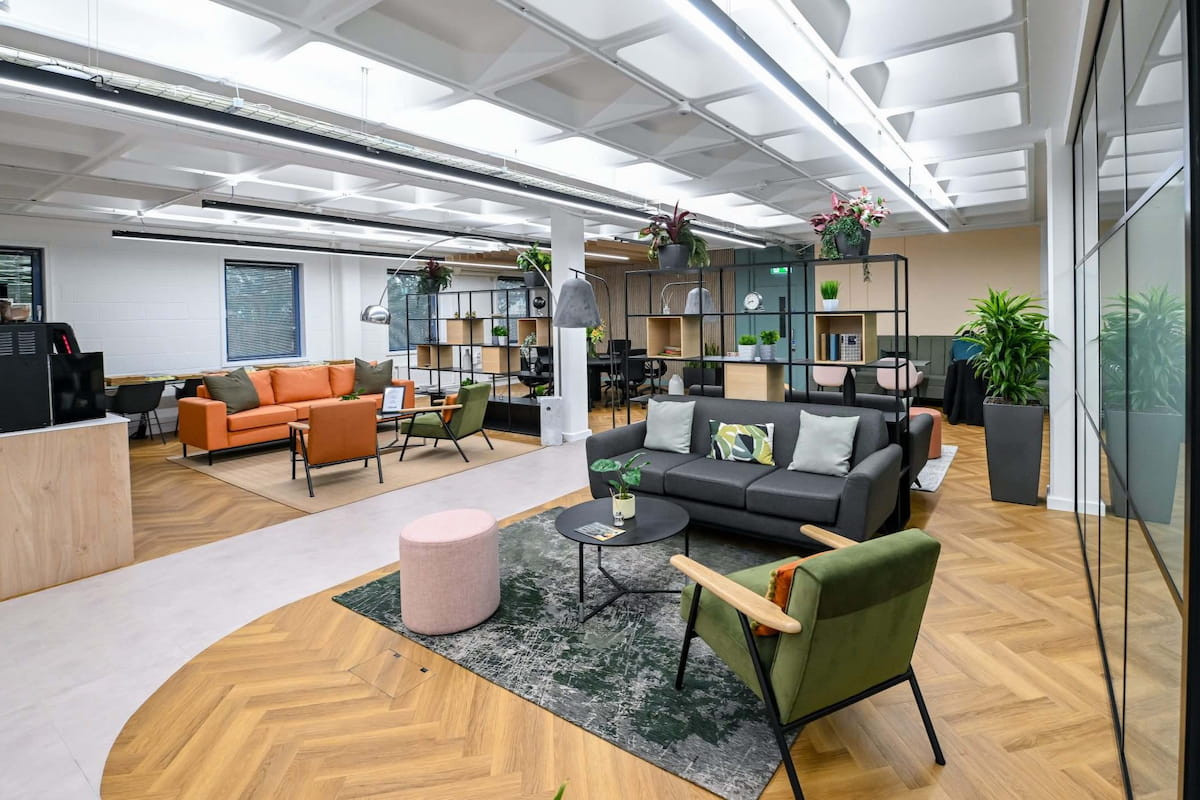
Coworking gives individuals access to a shared workplace rather than providing an entire private office for their business.
You may use an available desk each day, have a dedicated desk or buy a membership allowing access for a specific number of days each month.
Cambridge currently has several very different coworking models.
ideaSpace offers founder-focused coworking across three locations. Its full-time membership currently costs £315 + VAT per month, while one-day-per-week membership starts at £100. Full-time members have a 30-day notice period after an initial three-month minimum.
Serendipity Labs Cambridge North currently charges £349 per month for unlimited coworking or £249 for ten days each month, both on monthly agreements.

Advantages of coworking
Coworking keeps the financial commitment low.
There is no fit-out to organise, internet and furniture are already there, and businesses can avoid paying for a permanent desk that an employee only uses twice each week.
For Cambridge founders, it can provide another benefit: access to a relevant community.
ideaSpace, for example, describes itself as a community for founders and entrepreneurs and provides events and ways to connect with members across its three sites.
Disadvantages of coworking
Privacy and consistency are the main compromises.
Your company may not sit together every day. Meeting rooms are shared. Confidential calls can require booths or booked rooms, and the workspace has limited connection to your own brand.
Coworking also becomes harder to justify as a permanent solution once a team becomes larger.
Ten memberships may work.
Fifty people trying to operate as one company from a shared coworking environment is a very different proposition.
What is a serviced office?
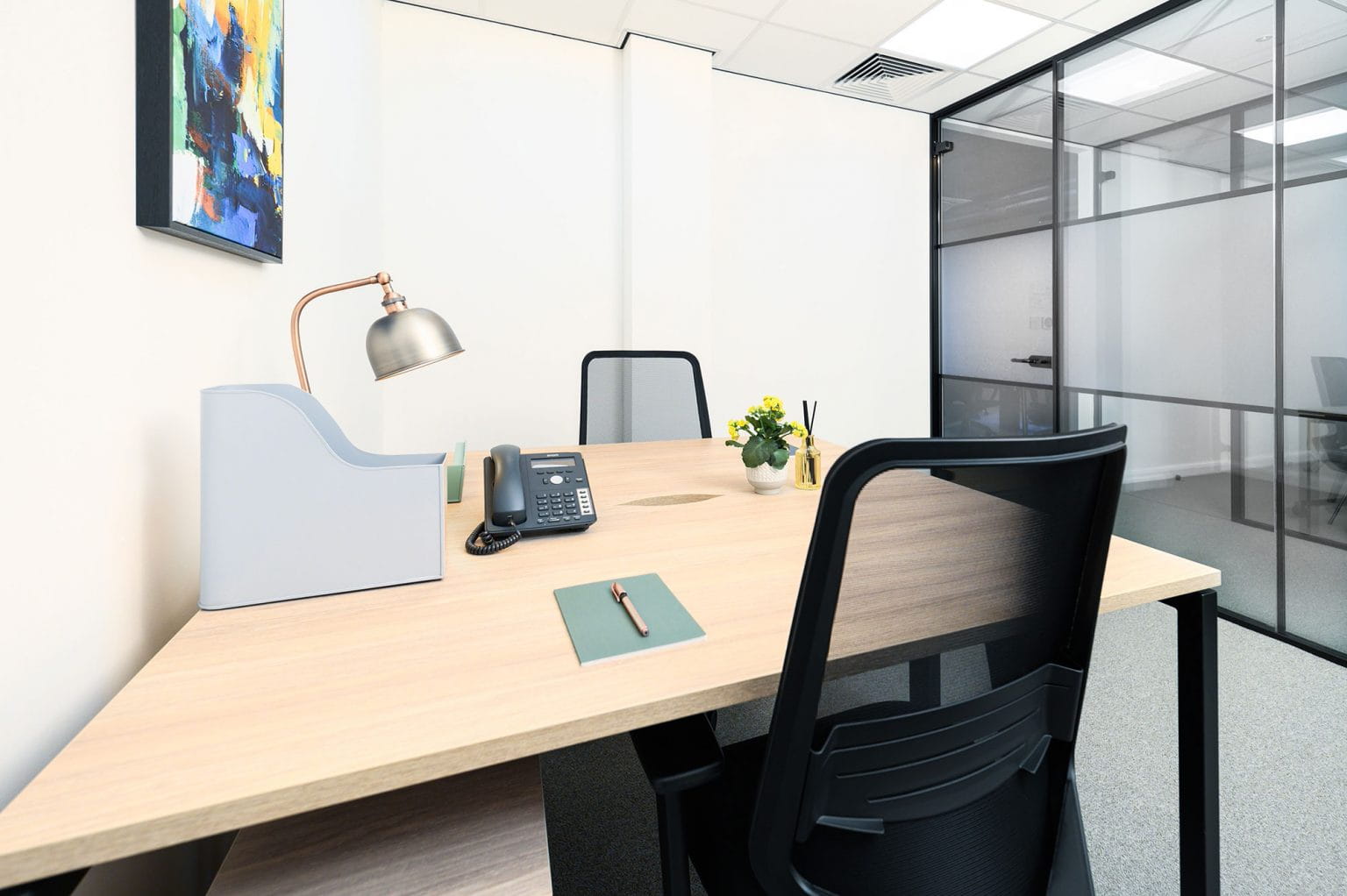
A serviced office gives your company a private room or suite inside a building operated by a workspace provider.
It is usually furnished and ready for immediate use. Utilities, internet, business rates, cleaning, maintenance and shared facilities are commonly bundled into the monthly price, although meeting rooms, printing, parking and specialist connectivity may still cost extra.
A realistic Cambridge planning figure is approximately £500 per desk per month, although location creates a very wide range.
Advantages of serviced offices
The biggest advantage is reducing both commitment and operational work.
A team can move into a furnished private office without arranging broadband, buying desks or running the building.
It is also easier to respond to headcount changes. Knight Frank notes that serviced space is particularly useful for new and scaling companies whose headcount is difficult to predict, with typical terms around 12–18 months and some smaller spaces available monthly.
Disadvantages of serviced offices
The company has less control over the space.
Furniture, shared meeting rooms and communal areas normally belong to the operator’s overall environment rather than your own brand.
The per-desk model can also become significant as headcount grows. Cambridge’s £500 benchmark means 40 desks equate to roughly £20,000 each month.
At that point, a business should at least compare serviced space with managed and traditional options rather than automatically renewing.
Read our guide to serviced offices in Cambridge
What is a managed office?
A managed office sits between serviced workspace and a traditional lease.
Instead of taking a standard ready-made private room, your business normally gets a more dedicated environment that can be configured around its own needs.
That might include:
- dedicated meeting rooms
- your own kitchen or breakout area
- company branding
- customised desk layouts
- specific IT requirements
- more control over access and privacy.
The operator still handles much of the property management.
Cambridge Offices describes self-managed space as giving companies greater control over branding and layout while retaining more flexible agreements and support than a conventional lease. It highlights the model particularly for growing science, technology and research businesses that need greater privacy.
Advantages of managed offices
Managed space allows the office to start feeling like your company’s workplace, rather than simply a room inside somebody else’s coworking building.
That becomes increasingly valuable for Cambridge businesses handling sensitive research, confidential data or specialist technology.
It also removes much of the operational work associated with conventional leasing.
Tally describes managed space as typically including fit-out, furniture, IT, utilities, cleaning and day-to-day management within one monthly arrangement.
Disadvantages of managed offices
Customisation requires greater commitment.
Managed terms typically run around two to three years, rather than the shorter agreements common in serviced offices. A space requiring a new fit-out may also need around 12 weeks before occupation.
It therefore makes less sense if your 15-person company genuinely has no idea whether it will need eight or 40 desks next year.
Read our guide to managed and self-managed offices in Cambridge
What is a traditional office lease?
A conventional lease gives your business the greatest control.
The company leases an agreed area directly from a landlord for a fixed period and becomes much more responsible for creating and operating the workplace.
Traditional office rents are generally quoted per square foot per year rather than per desk per month.
Cambridge’s 2026 price index reports prime conventional office rent of up to approximately £68.50 per sq ft per year.
Specialist life-sciences space can be higher: Cushman & Wakefield reported Cambridge prime life-science quoting rents at £77 per sq ft in Q2 2026.
Those are prime figures, not Cambridge-wide averages.
More importantly, rent is only the beginning.
A leased office can also introduce:
- business rates
- service charges
- design and fit-out
- furniture
- internet
- utilities
- cleaning
- insurance
- maintenance
- professional and legal fees
- dilapidations when leaving.
Knight Frank also notes that conventional office space is typically more generous, allowing close to 100 sq ft per employee, compared with roughly 30–70 sq ft per desk in flexible workspace.
Advantages of a traditional lease
The company controls the workplace.
Layout, meeting rooms, laboratories where permitted, branding, security and employee facilities can all be planned around the business.
For a company that knows it will occupy broadly the same amount of space for many years, spreading setup costs over a long period can make sense.
Disadvantages of a traditional lease
The business carries more risk when its requirements change.
Knight Frank says conventional leases normally require at least three years and that moving into leased premises can take approximately three to six months once paperwork, legal requirements and fit-out are taken into account. Flexible offices can often be occupied within two to four weeks.
That difference matters to a Cambridge startup moving quickly after investment or a research company whose space requirements may depend on future milestones.
Read our guide to renting office space in Cambridge